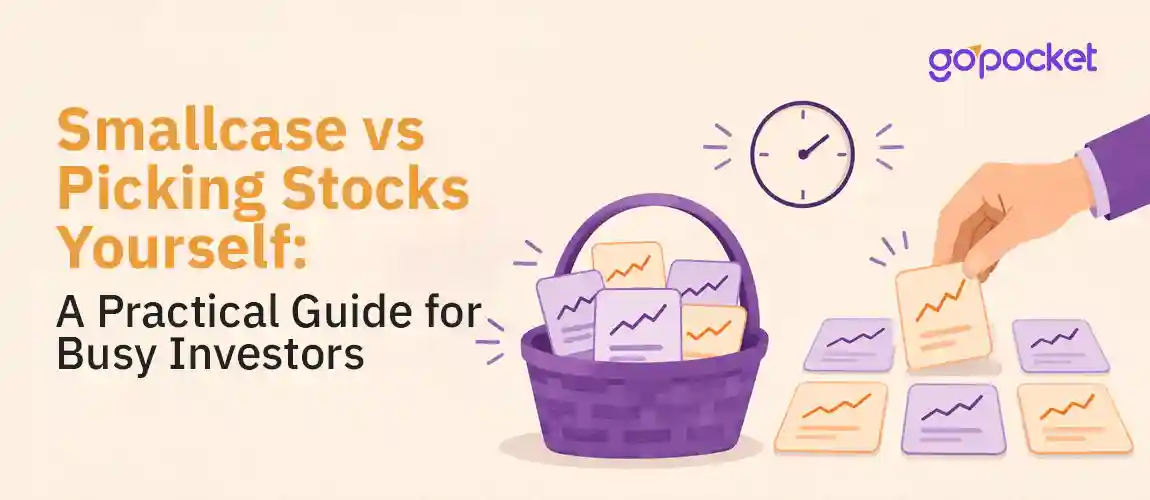
SMALLCASE VS PICKING STOCKS YOURSELF: A PRACTICAL GUIDE FOR BUSY INVESTORS
Two friends, Arjun and Meera, started investing the same month with the same amount: Rs. 1 lakh. Arjun spent his weekends in broker apps, screeners and YouTube videos, hand-picking 18 stocks he was convinced would fly. Meera spent twenty minutes picking a ready-made basket of stocks built around a theme she believed in and let it run.
A year later, Arjun had spent roughly 150 hours on research, three of his picks had halved, and he hadn't rebalanced once because he "didn't have the time." Meera had spent about four hours all year, her basket had been rebalanced twice by the people who built it, and she couldn't tell you the price of a single stock inside it without checking.
Neither of them is wrong. They just answered a different question: not "which is better," but "which matches how much time, skill and attention I actually have."
That question is what this guide is for.
WHAT EXACTLY IS A SMALLCASE?
A smallcase is a ready-made basket of stocks or ETFs, built around one idea like banking, clean energy or quality large caps, and designed by SEBI-registered research analysts or investment advisors. When you buy one, the shares land straight in your own demat account. You own each stock directly, the same as if you'd bought it yourself. Nothing sits in a pooled fund the way it does with a mutual fund.
Think of it as a chef's thali instead of cooking twelve dishes yourself. Someone with training decided the combination, the proportions and when to swap a dish out. You still own what's on your plate, and you can always pick your own ingredients instead. You're just choosing not to, for now.
HACK 1: MEASURE TIME HONESTLY, NOT HOPEFULLY
Here's a hack most beginners skip. Before picking a strategy, time yourself doing one piece of real research: read one company's quarterly results and decide, honestly, whether you'd buy more. For most people, that takes 45 minutes to an hour, per stock, per quarter. Multiply that by the number of stocks in your portfolio, four times a year, and you'll have your real research budget, not the one you imagine on a free Sunday.
A ready-made basket outsources exactly this. The managers behind it do this research daily and rebalance the basket when the theme or the numbers shift, typically every month or every quarter, depending on the strategy. You can see every rebalance the moment it happens.
HACK 2: DIVERSIFICATION IS A MATH PROBLEM, NOT A FEELING
Most DIY investors believe they're diversified because they own "a lot of stocks." But owning 15 stocks across the same three sectors isn't diversification. It's one bet, worn fifteen ways.
A well-built basket is constructed to spread risk on purpose, often across sectors, market caps or strategies, with position sizes decided by a method, not a mood. That's the real difference: diversification by design versus diversification by accident.
HACK 3: KNOW WHAT YOU'RE ACTUALLY PAYING FOR
This is where most people guess instead of calculating. Here's what a ready-made basket typically costs, lined up against the two paths most investors compare it to.
| DIY STOCK PICKING | READY-MADE BASKET | PORTFOLIO MANAGEMENT SERVICE | |
| Who decides what to buy | You | SEBI-registered analysts | SEBI-registered portfolio manager |
| Typical minimum investment | Any amount | Roughly Rs. 2,000 to Rs. 25,000+, depending on the basket | Rs. 50 lakh (SEBI-mandated minimum) |
| Who holds the shares | You, in your demat | You, in your demat | The manager, on your behalf |
| Rebalancing cost | Your own brokerage each time | Usually no extra fee, just normal brokerage on the trade | Often built into a management or performance fee |
| Ongoing cost | Brokerage only | Often a subscription fee, roughly Rs. 500 to Rs. 2,000 a year for paid baskets; some are free | Management fee, commonly 1% to 2.5% a year, sometimes plus a performance fee |
| Who you can blame if it underperforms | Only yourself | A professional with a track record | A professional with a track record |
Notice the gap between a ready-made basket and a PMS. A basket gets you professional selection and real diversification at a fraction of the PMS entry ticket, because you're buying research and a method, not a dedicated manager.
HACK 4: REBALANCING IS THE CHORE EVERYONE SKIPS
Ask any DIY investor when they last rebalanced their portfolio, and most will go quiet. Rebalancing means trimming what's grown too large and topping up what's fallen behind, so your original plan doesn't quietly turn into a different portfolio. It's unglamorous, and it's also the single habit that separates disciplined investors from lucky ones.
With a ready-made basket, this happens for you on a set schedule, and you get an alert to apply the update with one tap. With DIY stocks, rebalancing competes with your job, your weekend and your willpower. Willpower usually loses.
THREE INVESTORS, THREE HONEST ANSWERS
The Beginner. New to the market, not sure how to read a balance sheet yet, and nervous about picking the "wrong" stock. A ready-made basket gives professional selection and built-in diversification from day one, while you learn the ropes without carrying the full weight of research on your own.
The Busy Professional. Has the income to invest seriously but not the hours to track 15 companies every quarter. This is Meera's lane. A basket matched to a clear theme does the ongoing work, and the busy investor spends their saved hours on the career that's actually paying for the investments.
The DIY Enthusiast. Genuinely enjoys reading annual reports, has the time most weekends, and treats research as a hobby, not a chore. This is Arjun's lane, and there's nothing wrong with it, as long as the hours are real and the rebalancing happens. Many DIY investors use a hybrid approach: a core of baskets for steady diversification, with a smaller slice of hand-picked stocks for the ones they've genuinely researched.
THE NUMBER THAT SHOULD MAKE YOU PAUSE
Before you decide you're the DIY type, consider this. A market survey commissioned by Samco Securities found that 67% of retail stock market investors failed to beat their benchmark index, with annual underperformance estimated at 4% to 5%. The same survey found 65% of investors couldn't even say what return they'd made. Confidence in your own stock picks and actual performance are often two very different things, and the only way to know which one you have is to check, honestly, at least once a year.
YOUR DECISION IN FOUR QUESTIONS
- Can I honestly give these one to two hours a week, every week, not just the weeks I feel like it? If no, a ready-made basket fits better.
- Do I rebalance on a schedule, or only when a stock has already fallen too far? If it's the second, you need the discipline a basket builds in automatically.
- Am I diversifying by a plan, or just by the number of stocks I own? Count your sector overlaps before you answer.
- Would I rather spend Saturday reading an annual report, or doing literally anything else? There's no wrong answer here, just an honest one.
Arjun and Meera are both still investing a year later. Arjun found he genuinely loves the research and has gotten sharper at it. Meera found she'd rather spend her Saturdays elsewhere and trusts the process she chose. Neither path made them a better or worse investor. It just matched the plan to the person.
Whenever you place your next trade on the GoPocket mobile app, remember you're never alone: GoPocket's hands are always there to guide you.