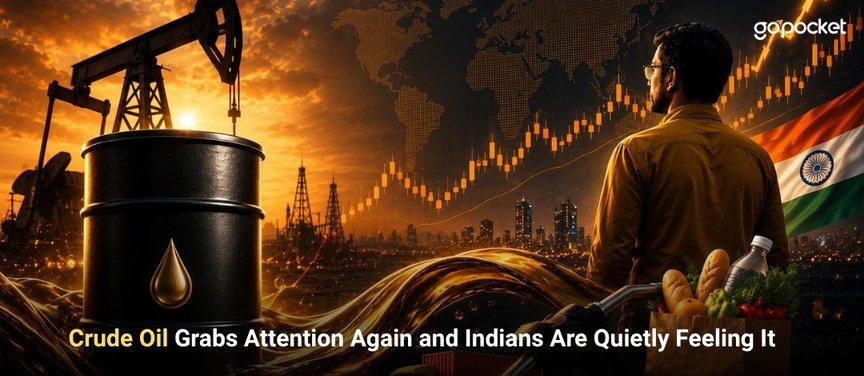
CRUDE OIL GRABS ATTENTION AGAIN, AND INDIANS ARE QUIETLY FEELING IT IN THEIR WALLETS
TODAY IS THE MORNING THAT LOOKS ORDINARY… BUT ISN’T
It was one of those normal Indian mornings where nothing feels unusual.
A car pulls into a petrol station. The engine stops. The silence feels routine. The driver doesn’t even look at the board. He already knows the drill.
“Rs. 1000 petrol,” he says.
The attendant nods. The nozzle clicks in. The meter starts rising:
Rs. 200… Rs. 500… Rs. 900…
Payment done. Receipt taken. Drive continues. No emotion attached. No second thought. Just another cost of living.
A few kilometres away, another scene unfolds quietly. A woman walks through a grocery store.
She picks essentials: rice, vegetables, cooking oil, milk and basic household items.
Nothing unusual. Nothing extra. But at the billing counter, she pauses for a second. The final number feels slightly higher than last month. Not shocking.
Just slightly heavier on the wallet. She doesn’t question it deeply. She adjusts mentally.
At the same time, on a mobile phone screen:
“SIP of Rs. 5000 successfully deducted.”
Markets are slightly volatile. Returns are fluctuating up and down- nothing extreme, just normal market movement.
And somewhere in the same household:
Food delivery charges have quietly increased again. No announcement. No headline. Just a small number change.
Different situations. Different expenses.
But one invisible force is moving behind all of them.
Crude oil.
Not seen directly. But felt everywhere.
ACT 1: WHY CRUDE OIL STILL MATTERS IN A DIGITAL INDIA
Crude oil is one of the most influential global commodities even in today’s digital economy.
In recent global market conditions, crude oil prices have generally moved in a range influenced by:
• global demand recovery patterns
• production decisions by major oil-producing countries
• USD/INR currency movement
• supply expectations and global risk sentiment
In many recent cycles, crude oil has hovered around the mid-$80 to mid-$90 per barrel range, reflecting a balance between supply constraints and demand uncertainty.
But the actual number is not what matters most. What matters is its role. Crude oil is the base cost of movement in the global economy. Everything that moves physically is influenced by it. Even if you never buy oil directly.
ACT 2: THE FIRST CHAIN REACTION FUEL AND TRANSPORTATION
The most direct link is fuel.
When crude oil rises:
• Petrol prices come under upward pressure
• Diesel becomes costlier to operate
• Transport companies adjust freight charges
But the real impact is deeper. Because fuel is not just used by individuals.
It powers entire systems:
• logistics trucks
• delivery networks
• agricultural transport
• factory supply chains
• public transport systems
So even if you personally don’t drive much, you still pay for fuel indirectly. Because everything you buy has already travelled.
ACT 3: WHY STOCK MARKETS REACT TO CRUDE OIL
Stock markets don’t move because investors trade crude oil directly. They move because crude oil changes expectations.
There are four major transmission channels:
1. Inflation Pressure
Higher crude → higher transport cost → higher product prices
2. Interest Rate Expectations
Central banks like the RBI monitor inflation closely.
If inflation rises, rate cuts may slow or pause.
3. Corporate Earnings Pressure
Companies face rising input costs, shrinking margins and cautious future outlooks
4. Foreign Investment Behaviour
Global investors reduce risk exposure when inflation risks rise in emerging markets.
So crude oil becomes a macroeconomic signal, not just a commodity.
ACT 4: SECTOR-WISE IMPACT
This is why institutional investors track crude oil carefully. Not for speculation. But for understanding the economic direction.
ACT 5: WHAT INVESTORS SHOULD ACTUALLY UNDERSTAND
The goal is not to fear crude oil.
The goal is to understand it.
Because:
• global oil prices are external
• macro cycles are uncontrollable
• geopolitical influences are unpredictable
But what can be understood is the relationship between crude oil and financial life.
Once this understanding improves:
• market volatility feels more logical
• SIP fluctuations feel less emotional
• investment decisions become more stable
This is the foundation of informed investing.
Master The Market With Gopocket
ACT 6: THE BIGGER PICTURE: WHY THIS MATTERS LONG-TERM
Crude oil is not just a short-term news factor.
It is a long-term economic driver.
Even in a future with electric vehicles and renewable energy:
• logistics systems still depend on fuel transition
• industries still rely on energy inputs
• global trade still depends on movement costs
So crude oil remains a macro anchor variable in global economics.
THE INVISIBLE THREAD ACROSS DAILY LIFE
The family in our story never thought about crude oil. They didn’t need to.
But it was present everywhere:
• petrol station
• grocery store
• SIP deduction
• delivery charges
One global force. Many daily outcomes.
FINAL THOUGHT
Crude oil is not part of the daily conversation for most people. But it is part of daily life in ways people don’t directly see.
So, the next time you:
• fill fuel
• buy groceries
• book travel
• or check investments
Remember one simple truth: You may not see crude oil. But you are already living inside its impact.